Client: Rocketvolpe (Digital Marketing Agency, India) Managed by: OESON (Marketing Internship) Platforms: Meta Ads (Facebook & Instagram) Campaign Type: Lead Generation – On Facebook Lead Forms. Duration: 4 February – 11 February 2024. Total Spend: $671.68. Total Lead Generation: 759
The Brief
Rocketvolpe needed to generate qualified leads for its SEO services — potential clients who would submit their contact details via a lead form attached directly to the ad. The goal was to build a pipeline of prospects for email marketing and sales outreach, targeting businesses and decision-makers likely to purchase SEO services.
As part of the OESON internship programme, Khomesh was tasked with planning, writing, and executing the full lead generation campaign on Meta — including ad copy, creative coordination, campaign setup, audience targeting, and performance analysis across 3 campaigns run simultaneously.
The Challenge
- No existing lead database or warm audience to target — cold traffic.
- Only Lead generation for professional services (SEO) is a competitive and high-CPL category on Meta.
- Multiple campaigns needed to run in parallel, each requiring independent setup, monitoring, and optimisation.
- Ad creative had to communicate a clear value proposition to business owners unfamiliar with Rocketvolpe.
- As an intern, this was end-to-end ownership of a live client lead generation programme.
Campaign Structure
Three campaigns were run across the same period, each with different ad sets and creative configurations:
| Campaign | Ad Sets | Leads | Spend | CPL |
| SEO Leads Campaign | 2 ad sets | 586 | $355.69 | $0.61 |
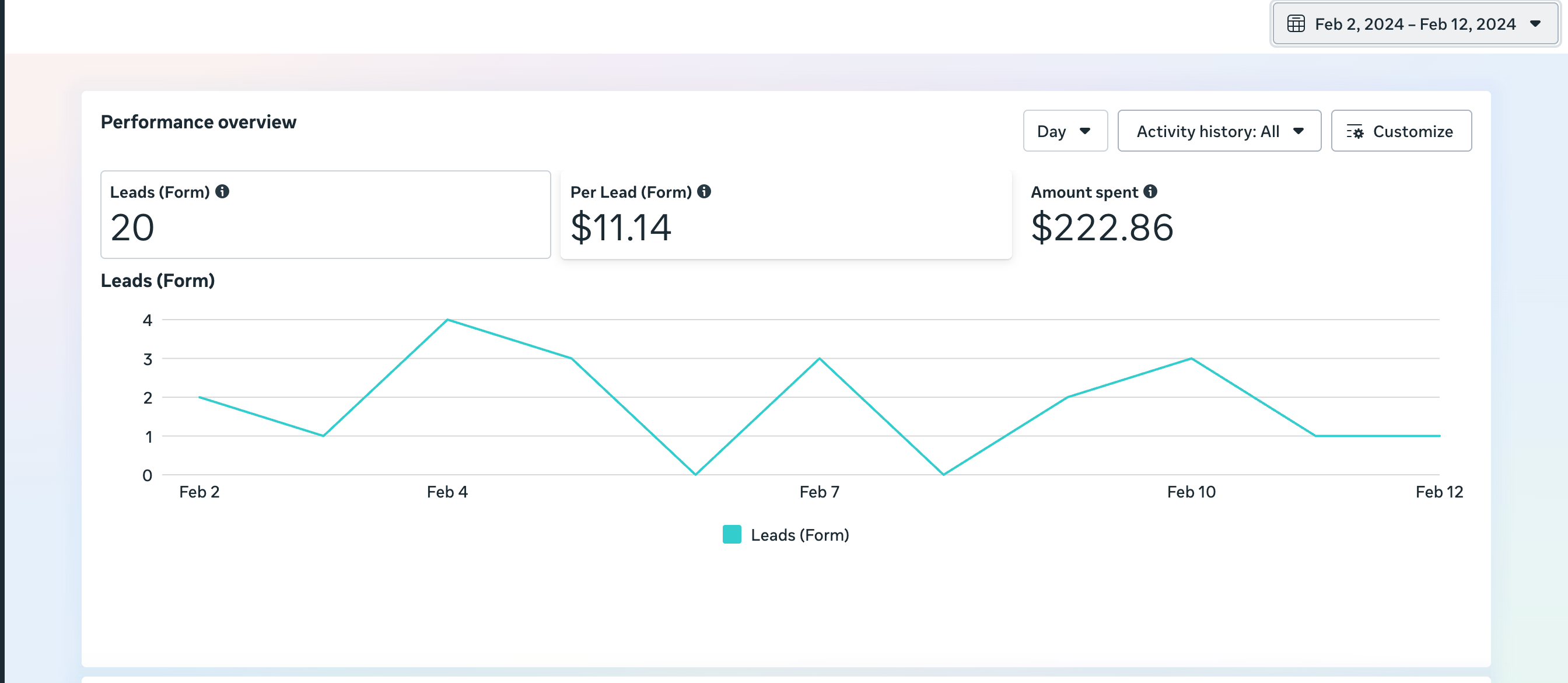
| SEO Leads | 1 ad set | 20 | $222.86 | $11.14 |
| SEO Leads Ad Campaign | 1 ad set | 153 | $93.13 | $0.61 |
| Total | 4 ad sets | 759 | $671.68 | $0.88 blended |
My Strategy
On-Facebook Lead Forms over website landing pages: Rather than driving traffic to an external landing page, I configured all campaigns to use Meta’s native On-Facebook Lead Forms — forms that open directly within the ad without requiring users to leave the platform. This reduces friction significantly, as users don’t need to wait for an external page to load. For cold audiences unfamiliar with Rocketvolpe, reducing drop-off at the click stage was critical to keeping CPL low.
Two-ad-set structure for Campaign 1: The primary campaign (SEO Leads Campaign) was structured with two parallel ad sets targeting different audience segments simultaneously. This allowed Meta’s algorithm to optimise delivery across both segments and identify which audience responded best to the lead form offer — while maintaining consistent ad copy and creative across both sets.
Ad copy written for business decision-makers: I wrote the Meta ad copy specifically to speak to business owners and marketing managers considering SEO services — focusing on the commercial outcome (more organic traffic, more clients) rather than technical SEO features. Collaborated with the team to translate the copy into a final ad creative aligned to Rocketvolpe’s brand.
Execution
- Wrote Meta ad copy for all campaigns targeting Rocketvolpe’s SEO services audience.
- Configured 3 campaigns with 4 ad sets using On-Facebook Lead Form objective.
- Set up audience targeting for each ad set based on business owner and marketing decision-maker interest signals.
- Coordinated with the creative team to produce ad visuals aligned to campaign copy.
- Launched all campaigns 4 February 2024 and monitored daily performance.
- Identified and analysed the significant CPL variance between campaigns.
- Documented performance findings and creative insights for future campaign optimisation
Results
| Metric | Result |
| Total Leads Generated | 759 |
| Blended Cost per Lead | $0.88 |
| Best CPL achieved | $0.61 (Campaigns 1 & 3) |
| Worst CPL | $11.14 (Campaign 2) |
| Total Amount Spend | $671.68 |
| Campaign Duration | 2-24 February (peak: 4-11 Feb) |
The headline result: 759 Leads at $0.88 blended CPL
For context, average Meta CPL benchmarks for professional services (including digital marketing and SEO) typically range from $5 to $30+. Achieving a $0.88 blended CPL — and $0.61 CPL on the two best-performing campaigns — represents performance significantly below industry benchmark, driven by strong audience targeting, effective ad copy, and the right lead form configuration.
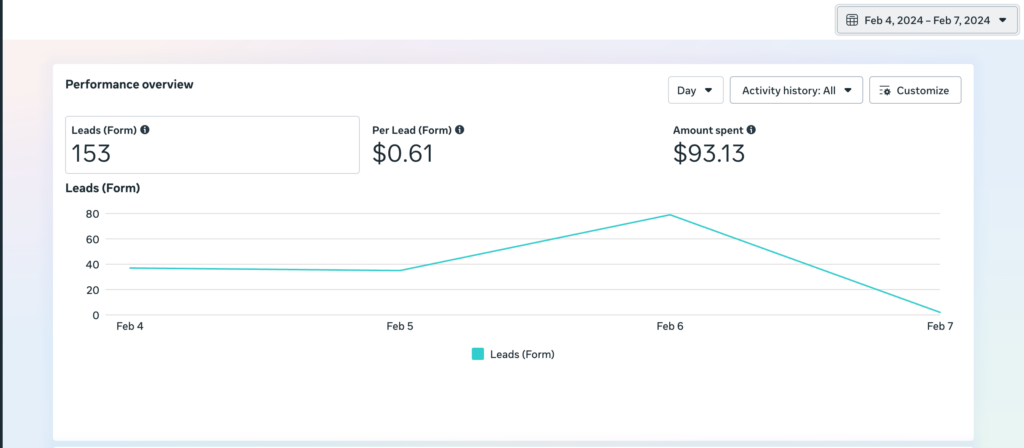
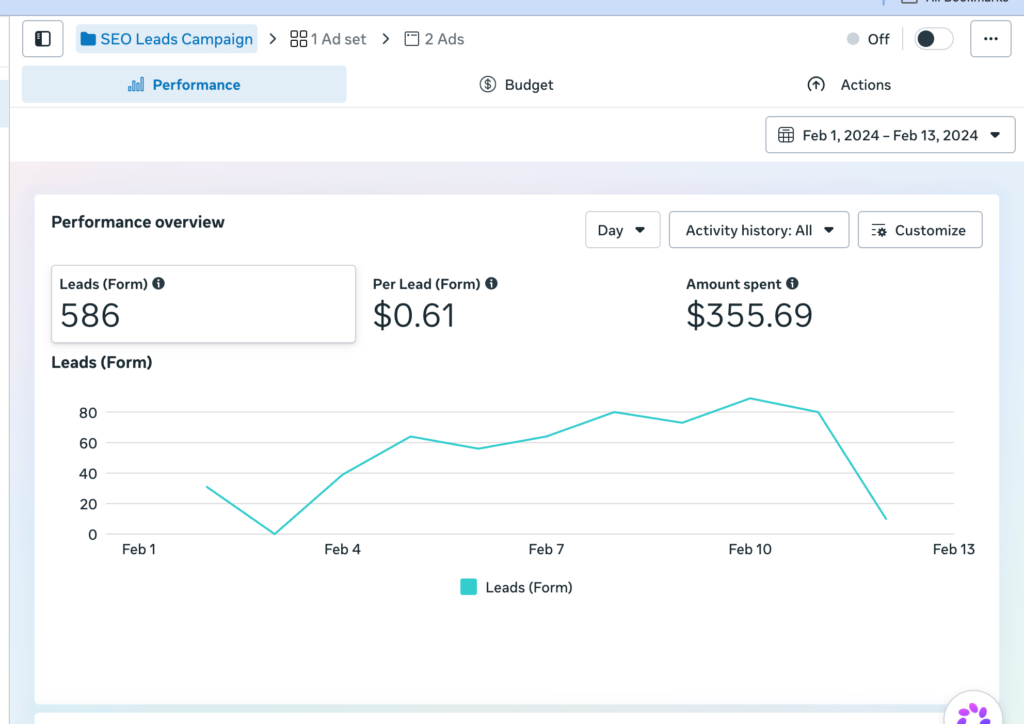
The Critical Insight: What Caused the $11.14 CPL in Campaign 2
Campaign 2 (SEO Leads) generated only 20 leads at $11.14 CPL — 18x more expensive than the $0.61 CPL achieved across the other two campaigns. The root cause was identified as a creative mismatch on the Facebook Mobile Feed placement: the ad creative for this campaign did not match Rocketvolpe’s brand colours, creating visual inconsistency that reduced user trust and engagement at the point of impression.
This single creative error had a dramatic impact on performance:
| Campaign 1 & 3 | Campaign 2 | |
| CPL | $0.61 | $11.14 |
| Leads | 739 | $20 |
| Creative | Brand-aligned | Off-brand colors |
| CPL Difference | Baseline | 18x more expensive |
The lesson: On Meta’s Facebook Mobile Feed placement, creative alignment to brand identity is not cosmetic — it is a direct performance variable. Users scrolling a mobile feed make split-second trust decisions based on visual consistency. An off-brand creative signals unfamiliarity and reduces form completion rates dramatically, even when the audience targeting and copy are identical.
This finding directly informed how all subsequent campaigns were briefed: creative review against brand guidelines became a mandatory pre-launch step before any ad went live.
Campaign 1 Deep Dive: Peak Performance and Audience Fatigue
The primary campaign (SEO Leads Campaign) ran two parallel ad sets, both achieving identical CPL:
| Ad Set | Leads | CPL | Spend |
|---|---|---|---|
| Ad Set 1 | 298 | $0.61 | $180.33 |
| Ad Set 2 | 288 | $0.61 | $175.36 |
| Total | 586 | $0.61 | $355.69 |
The near-identical performance across both ad sets — despite targeting different audience segments — validated that the lead form creative and copy were strong enough to convert across multiple audience configurations at the same cost efficiency. This consistency is a strong signal that the creative and copy were the primary performance drivers, not audience luck.
Peak vs Decline: The Audience Fatigue Pattern
Campaign 1 launched on 2 February, generating 31 leads on day one before dropping to 0 leads on 3 February. From 4 February, the campaign picked up strongly, scaling to a peak of 80 leads on 11 February. By 12 February, daily lead volume had dropped to 10 leads — an 88% decline in 24 hours.
| Phase | Period | Daily Leads | Signal |
|---|---|---|---|
| Early launch | 2 Feb | 31 leads | Initial traction |
| Dip | 3 Feb | 0 leads | Algorithm learning phase |
| Scale | 4–11 Feb | Up to 80/day | Strong creative resonance |
| Decline | 12 Feb onwards | ~10/day | Audience fatigue |
| Peak window total | 4–11 Feb | 545 leads | 93% of total campaign volume |
eqioyjmdnddsviyvvrxvusxpuqdohf
xjxxmskritpqlorntypegiyxqlwduo